Thursday, April 9, 2015

Root Differences

When I was in high school, I noticed a curious pattern: one plus three equals four, plus five equals nine, plus seven equals sixteen, and so on. Each whole square was a certain number greater than the next, and the difference between the squares would increase by two every time. When I mentioned this to a math teacher, she either did not see it that way or misunderstood my phrasing, for she dismissed it as simple coincidence, not a natural law. After class, however, I was not convinced. Stubbornness is both a vice and a virtue of mine, and I continued to puzzle over how a series of odd numbers, increasing by two each time, connected to the succession of perfect squares.
Eventually, I drew the pattern out on scrap paper and saw something interesting: each square on a grid increases by the addition of new units to a side; being two-dimensional, they increase by two new units each time--one for each dimension.
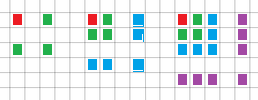
perfectimundo.png
We came up with an equation that represented the pattern. Since we want to look at the difference between squares (how much you add to get the next whole square), we added 1 to r, which stands for the square root. There’s the 2 pattern!

(r+1)2 = r2+2r+1

But I was still not fully satisfied. Something felt missing. I reasoned that if one could calculate differences between squares, surely a similar pattern might hold true in three dimensions--that is, whole cubes. The formula would be more difficult to visualize, but fortunately, my friend Ray owned a bowl of small cubes which we used to crack this puzzle. Three new squares would need to be added with each successive layer, and by holding cubes together, we discovered that the edges between sides would also need to be accounted for.
[insert “cube edges” visual]
We determined that the formula is:

(r+1)3 = r3+3r2+2r+1

Applied fascination, when shared with other curious thinkers, spurs the creation of wonders.

Thursday, April 2, 2015

Why We Love Dragons

Among various fantasy-geek communities, dragons seem a prevalent source of admiration.
Of course, dragons are awesome.

But why? What has kept them from turning out as, say, vampires did?

I cannot speak for everyone, but I feel that they possess a combination of remarkable traits:

  • They often embody elements (usually fire), and the four Classical elements continue to play a role in both fantasy and reality. Some dragons also spit venom or work magic.
  • They combine several animalistic features that fascinate humans: flight, scales, horns, a spaded tail, barbels, feathers, fur... (Not all dragons possess all of these aspects, obviously. I am aware of wyverns, drakes, wyrms, knuckers, etc.)
  • They are at once distant and nearly human. Whether they have humanlike greed and malevolence (like Smaug) or empathize with human emotions (like Saphira), I find that anything so physically different from us that still thinks like us is something our minds find intriguing.
  • They represent flight--literally as well as of the human imagination. Discounting planes and the like, humans cannot fly, and we love to imagine the "what if...?" scenarios of being able to do so.
I'm sure I missed several things, and some fascinations are simply difficult to justify, but these are my two cents at the moment.

Of course, dragons are hugely diverse in literature, cinema, and folklore, as I mentioned, but they will likely always hold a special place in my heart. Perhaps a plug of Oberon Zell-Ravenheart and Ash "LeopardDancer" DeKirk's book, Dragonlore, is in order here. It contains a wealth of information about mythological dragons, from Pa snakes to the Stoorworm to Chinese Lung dragons to the Tarasque, and beyond.

May the stars watch over all of you!

Major Waffling

Ever since my later high school days, I've been indecisive about my career path. Ideally, I'd major in English and minor in Creative Writing. However, I also feel that I ought to take advantage of the presented opportunities to learn new things and secure a career.
I feel that a job in STEM would enable me to further forge paths of research (not to mention pay off loans more quickly), but I feel that the liberal-arts half of my brain would lend me a more rounded education. And besides, don't the sciences require just as much creativity as the arts? Without radical, outside-the-box thinkers, we'd have neither Apple nor Microsoft. Conversely, many successful science-fiction writers had a firm grip on real science. Combining vastly different elements in unique ways is no guarantee of success, but it certainly doesn't seem to harm one's chances or mindset.
I currently intend to double-major in English Literature and Computer Science, with possible minors in any combination of two or three of the following: Classics, Physics, Mathematics, Art, or a foreign language. Eventually, I'd like to write full-time, but I wouldn't mind a job in the software business while my written endeavors take off. I could even blog about technology in addition to writing fiction and screenplays (and occasionally, poetry).
We need to stop pigeonholing careers and educational paths. Often, a fresh perspective is just what the world needs.

Sunday, March 29, 2015

Mathematics: The Language of the Universe


"Mathematics is the language in which God has written the universe. - Galileo Galilei


Throughout childhood and adolescence, I often questioned why math was important or relevant. Questioning everything is admirable, but I often stopped before arriving at satisfactory answers. After a time, I began to see math as interesting but often irrelevant to daily life, as did many peers.

I did not realize then that mathematical and philosophical logic are deeply intertwined, that math can be both exhilarating and cathartic, or that the cognitive growth acquired by constantly solving more difficult problems than before can be applied to myriad fields, from medicine to business to theatre to national security. Even when one is not actively calculating numbers, the combination of rigorous logic and unrestrained creativity is a powerful cure to boredom and blockage.

Math is also, in a way, flawless: humans make mistakes, and computing systems may glitch from time to time, but pure, intangible numbers and patterns click perfectly--whether or not we are aware.

Students in a classroom may stare out at a lovely autumn afternoon and wish they were outside, away from pedagogical lectures, but math is everywhere. It is the blueprint for physics, after all.

One of my more mathematically-oriented friends suggested that STEM become STEAM (Science, Technology, Engineering, Arts, and Mathematics), as creativity is a crucial element in the sciences.

So instead of convincing children (particularly girls) that math is difficult tedium, adults need to alter our own mindsets to positively influence the new generation.

Math is beautiful. Math is natural.

Math is fun.

Friday, March 27, 2015

Thoughts on Ambitious First Projects

(Disclaimer: I am not an expert, and these are only my musings and predictions.)

Many budding writers - myself included - are often told to "start small," usually meaning to first sell short stories or poems before progressing to things like screenplays or novels. The latter is often recommended to be restricted to stand-alone novels or films, emphasizing also that said first novel or script should not be too long. (Mostly novels, as screenplays are required to stop at 128 pages.)

But I wonder if that is not always the case. David Farland once suggested to write what one wants to write, be it serial or singular, depending on the individual tales' needs. (Tom Doherty said something similar when he appeared on Writing Excuses.)

For instance, I have several stand-alones and quite a few series mapped out--some being trilogies, others consuming every number between four and seven volumes, and one whopping nine-volume cycle. (The "trilogy of trilogies," as I'm calling it for now, has a more or less definite story arc for each volume, but I won't spoil it here!)

Am I using sequel bait? I'd like to think not, although that isn't always a terrible thing, either. Many of these wrap up one story arc but either open another or are nested within a larger conflict.

My very good friend and mentor recently helped me form the skeleton of a middle-grade comedic fantasy novel (now forming sinews and muscles, in case you wondered). This project holds its own story, but I can see it becoming a trilogy or tetralogy; it's sequel-flexible, like Cornelia Funke's Inkheart or the first Pirates of the Caribbean movie. It can stand on its own, but if I feel that an extension can comfortably be added, I won't hesitate. And no, I'm not in it for the money; gods know that I don't make any from writing nowadays.

The other issue is large books. Something like The Stand or War and Peace or Les Misérables or The Count of Monte Cristo. Much like series, starting out by publishing giant novels is said to be difficult. I'm still trying to figure out how to expand my own "novels" (which are way too fast-paced) to a proper scope, but I think the same principle applies of not compromising too much at the expense of one's work. Cuts are necessary, obviously, but one must hew close enough but not too close to separate content from fluff.

The great thing about large novels, in my opinion, is that they can inspire multiple films or even a television series, like many modern YA adaptations or Game of Thrones. One of my current stories is one long novel and three screenplays to capture the entire plot (yes, I adapt my own work).

Of course, this advice may not be fit for all; this is mainly how I view it for my own literary career.

PS. - I'm trying to blog more now. Humblest of apologies for my insanely long and unintentional hiatus.